Friday, March 4, 2016

Step 4: Photographing Shadows

When photographing shadows, I use a Canon 5D mark iii camera body (purchased, in part, with a 2013 Chris Clark Fellowship from the Arts Council of Greater Lansing) and depending on the size of the plant, either a 24-70 mm or 100 mm macro lens. The shadow is captured on a piece of foam core, either held by hand or by placing it on the ground.

I often shoot in nature preserves and areas where it's important not to disturb the surrounding plants or ground. Therefore, I avoid touching the plant and rarely, if ever, use a tripod. Whenever possible, I go out with a steward, botanist, or researcher who knows where and when the plants are blooming. I rely heavily on such individuals and wouldn't have gotten this far in the project without their trust and expertise. Trust is a key factor as many of the plant species on the endangered list are at risk for being poached. I have, on more than one occasion, agreed to keep secret the location of species I have photographed. 

The best days for photographing shadows are days with bright sunshine and little to no wind. Early morning or late afternoon is preferred because of the long shadows. I look for shadows that make a nice composition, which usually means photographing several different plants until I find the right angle. It's great when I can photograph the plants in bloom, but some plants have more visual interest right before they bloom or as they begin to decay. Sometimes it's the seed pods or the remaining heads that make the most interesting shadow. I've also discovered that not all plants create intriguing shadows - some just look like blobs. This summer I'll be visiting some of the blobs again to see if I can get a better angle.

The other challenge is trying to get as much of the shadow in focus as possible, as the part of the plant closest to the whiteboard is obviously the sharpest. However, sometimes having part of the image out-of-focus adds to the composition and aesthetic of the image. So it's just trial and error, following my gut......and sometimes just working with what I've got. :)


Tuesday, February 23, 2016

Step 3: Making Paper

Making paper is one of my favorite parts of this project as it reminds me of working in the darkroom. I love that it's incredibly tactile and that there is something very primal and grounding when sticking my hands in the stinky, murky water.

My 6x9 inch mould and deckle was purchased from Lee McDonald. (Though you can also buy some nice sets on Etsy or make your own.) The mould (left) is a screened frame that catches pulp to form the sheet of paper. The deckle is a frame that sits on top of the mould. It catches pulp and defines the edge of the paper.


In the pictures that follow, I'm pulling a sheet of garlic mustard paper.


The same thing in video:


The paper is couched (transferred) onto a sheet of cotton fabric (old bed sheets work wonderfully) and another cotton sheet is placed on top. Then a piece of wool (or in my case, fleece) is placed on top. And then you repeat. Once you've made a few sheets of paper, it's time for pressing. Professional paper artists have a heavy-duty press like this one (belonging to Karen O'Neal).


Paper-making photographers like myself use a wooden board, one hundred pounds of hand weights, and one hundre.......uh, a good amount of body weight to press the paper. I stand on it as long as I can before losing my balance and/or patience. I've been researching how to make a small hydraulic paper press to make this process a bit easier - and the paper a bit stronger.


After the paper is pressed, I peel away one side of the fabric and lay the pulp side down on Plexiglass to dry. I usually put newspaper on top as well, which helps to absorb moisture and promote even drying of the sheets. Without the newspaper, the sheets tend to buckle and end up back in the chopper.


Beautiful garlic mustard paper.

Monday, February 15, 2016

Step 2: Making Pulp

I cut off the roots and seed heads at the collection site, if possible, and bag them for disposal in the public trash. If the collection site is not conducive to hanging out for a bit, then I do this back in my garage and carefully gather any stray material for disposal in the public trash. No part of these plants should ever be composted. I then cut the remaining leaves, stems and stalks into 1/2-inch to one-inch pieces. They can be cut fresh or placed in a paper bag to dry for later cutting.


If you're working with tough plants such as phragmites, it helps to soak the cuttings in water for several weeks. This helps to break down the plant material before boiling.

The next step is to boil the cuttings (outside, due to the odor) for 3-4 hours with soda ash, which separates the lignin, sugars, starches, waxes, and gums from the cellulose fiber, making the paper strong and archival. Boil the plant material until it is soft enough to bend, but isn't mushy. In my experience, phragmites can take up to 3-4 separate boiling sessions before it's ready to be beaten in a blender.


After boiling, I rinse the plants thoroughly using paint strainer bags. 


Then the beating begins! This process would be quick and easy if I had an $8,000 Hollander Beater!


However, I have more time than money, so I use my sturdy KitchenAid blender in the laundry room. It can take 4 days to beat one bucket of pulp because the blender can handle only one cup of cuttings at a time. I beat each cup for 30-60 seconds and give my blender plenty of breaks so that it doesn't overheat. (Phragmites usually requires 3-4 rounds through the blender.) It's a sloooow process, but it allows for ample time to read, listen to music, and ...do laundry.


The cuttings are beaten until the pulp is soft and silky as pictured below. The pulp pictured below was processed with a Hollander beater that I rented. However, sometimes I prefer my paper to have a bit more texture, as well as a deckled edge, so I'm beating my pulp a little less and leaving a few more visible pieces to add to the texture of the paper. Figuring out the best consistency of pulp is simply through trial and error.


There are two invasive plant species that didn't work well for paper-making. One was Dame's rocket which never broke down enough to beat, even after several boilings. The second was common buckthorn which was extremely time-consuming to prep and resulted in brittle paper.

This summer, I'm anxious to try making paper with spotted knapweed, purple loosestrife, black and pale swallow-wort, narrow-leaf cattail, eurasian water milfoil, baby's breath, and any other herbaceous or aquatic invasive plant species I can get my hands on!

Wednesday, February 10, 2016

Step 1: Harvesting Invasive Plant Species

I'm so grateful for the positive feedback I've received on Foreshadowing and for the inquiries regarding the techniques I use. So over the next few weeks I'm going to post the step-by-step process involved in this project, starting with the harvesting of invasive plant species.

So far I've collected and experimented with five invasive plant species:
1- Dame's rocket (Hesperis matronalis)
2- Common Buckthorn (Rhamnus cathartica)

3- phragmites australis Subsp. australis


4- reed canarygrass (Phalaris arundinacea)

5- garlic mustard (Alliaria petiolate)

Of these five species, I am using three to make homemade paper: phragmites, reed canarygrass, and garlic mustard. I'll explain in a later post on making pulp why Dame's rocket and buckthorn didn't work.

It's imperative to know the best way to remove each plant in order to avoid spreading the seeds and causing further growth. Some plants also require a permit from the DNR for harvesting and transporting. The Michigan Natural Features Inventory is my go-to site for information on both invasive and native plant species in Michigan.

This summer I'm hoping to participate in/take advantage of organized invasive pulls at local nature preserves. I want to experiment with making paper out of Eurasian water milfoil, spotted knapweed, purple loosestrife, black and pale swallow-worts, narrow-leaf cattail, and any other herbaceous or aquatic invasive plant I can get my hands on. :) If you have these or other plants you'd like to donate to this project, please contact me!

Thursday, January 14, 2016

THANK YOU!

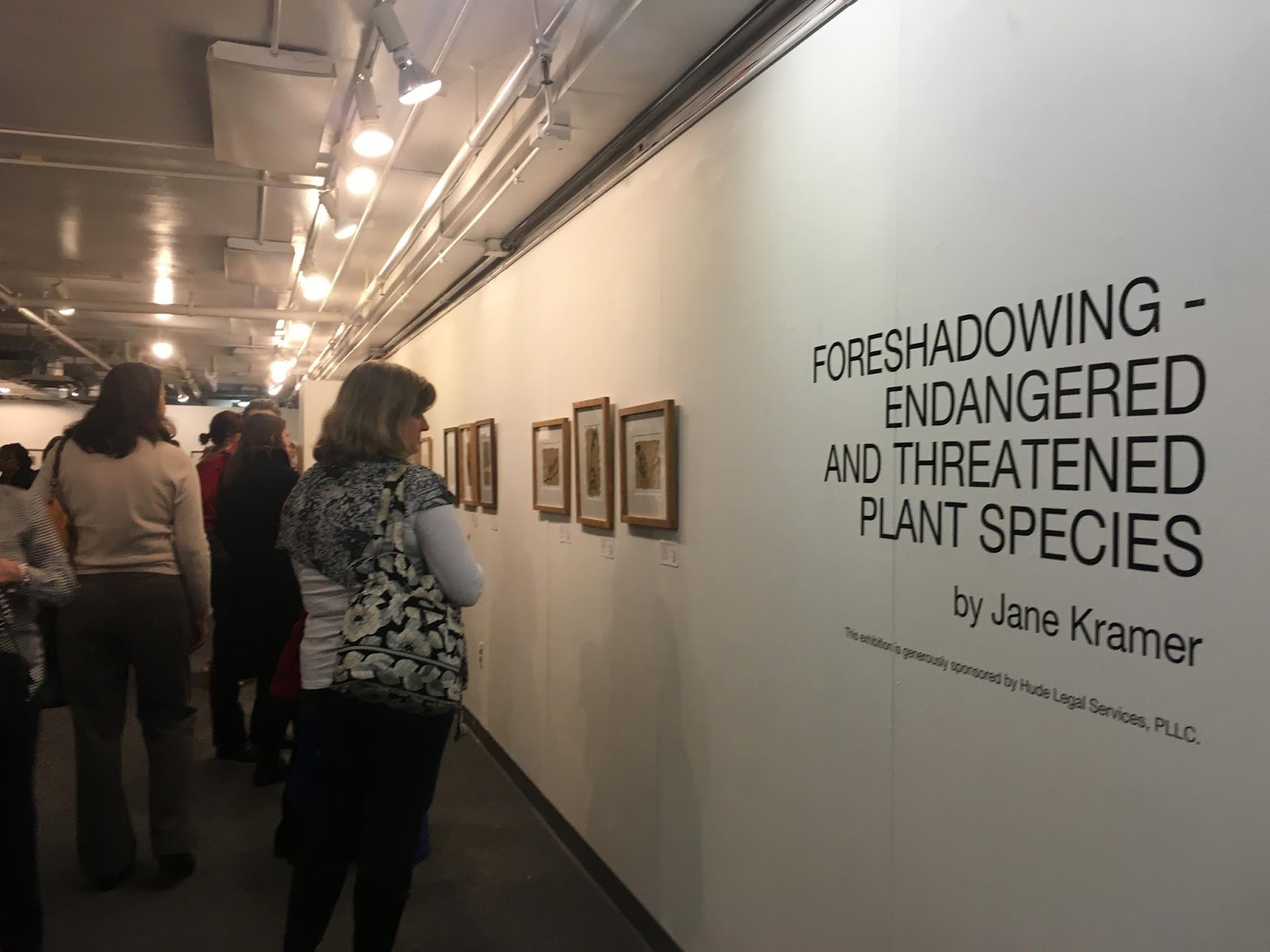
I'm still floating a few feet above ground since last Friday's opening. THANK YOU to all who came to the exhibit! I think we counted close to a hundred people and I can't tell you how grateful I am for all the support.

Not only was it fun to give the artist talk (once I got over my butterflies), it was also interesting to hear people's comments and interpretation of the work. I feel so incredibly lucky to be able to share what I love with others. When they appreciate the work, it's like "icing on the cake", or for me "chocolate sauce on ice cream".

The exhibit will be up until February 25th, so if you didn't get a chance to see it yet, please stop by. I would also be happy to meet any individuals or groups there to talk more about the process.

Lastly, I'm happy to make additional prints if you are interested in a piece that has already sold. I plan to continue collecting plant shadows this summer as well as experiment with new invasive papers, so there will be plenty more prints to choose from in the future.

Thanks again to Lansing Art Gallery, Michigan Nature Association, Dan Kramer and EVERYONE who helped me get this project going!


Friday, January 8, 2016

Ready to Go!


The prints are up and it is GO TIME!

Thank you Sara Pulver, Gallery Coordinator and SUPERWOMAN, for hanging the exhibit with me yesterday! It was so much fun!

The exhibit opens TONIGHT: 6-8 pm at Lansing Art Gallery. Be there or be..............whatever - JUST COME and have fun! :)


Thursday, December 31, 2015

Final Preparation for the Show!

I'm so excited for the show next Friday evening! Yay!

Dan finished the frames last week. I can't thank him enough! They are beautiful - made from reclaimed cherry, oak, and walnut.


I'm now on the final leg of putting the pieces together. I've cleaned all the glass and matched prints to frames. Tomorrow I'll pin them, attach hooks and wire, and pack them up for transport to the gallery next week. I may give you a sneak peek of one of the finished pieces. Or maybe I won't. You may just have to come to the show. :)