Friday, August 19, 2016

MSU's Kellogg Biological Station

It never hurts to ask. That's what I told myself as I was writing the letter to KBS asking if I could do an Artist Residency. I'm so very grateful to Katherine Gross and Kara Haas for allowing me to do so! And many thanks to Steve Hamilton, Tyler Bassett, and Dustin Kincaid for helping me locate both invasive and endangered/threatened plant species to use for my project. I can't even begin to imagine this project without all the wonderful people who have helped in so many ways.

Grad student Dustin Kincaid took me out in the canoe to find threatened wild rice.


You can see wild rice in the foreground, then invasive purple loosestrife and invasive phragmites behind that.


Susan Houseman lent me her row boat to get out to horsetail spike rush (special concern).


Steve Hamilton and Joe Simmons arranged for the collection of the invasive aquatic plant Eurasian watermilfoil which I hope to make into paper. 


And I had the honor of giving a workshop on making paper from invasive plants to a wonderful group of K-12 science teachers at the KBS Summer Institute! I hope you'll send me pictures of your projects so I know how they turned out. :)


THANK YOU KBS!!!


Monday, August 15, 2016

Plant and Paper Update

The results are in! After much experimentation, I was able to make the different types of paper pictured below. I'll be able to print on all of them with the exception of Japanese knotweed and the green garlic mustard. I also processed purple loosestrife and oriental bittersweet, but I could tell by the color of water during boiling that they'd be too dark, so I stopped there. I might make a few sheets this winter to see how they turn out, but right now I'm busy preparing for my exhibit at the Matthaei Botanical Gardens which opens September 17th. So back to work I go!


Tuesday, July 19, 2016

In Full Gear!

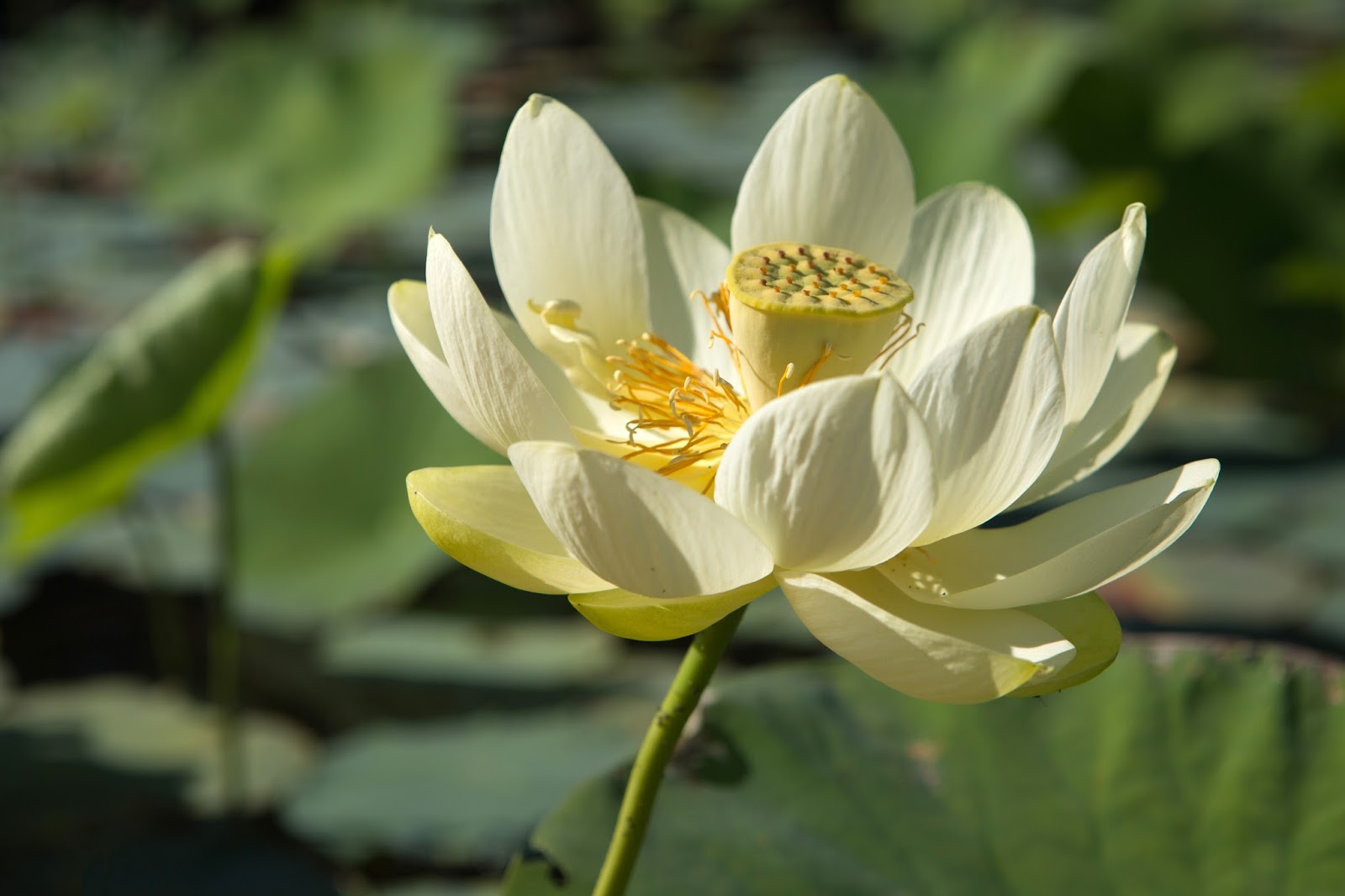
I've been on the go since my last post! Last week at Kent Lake, Rebecca Williams (from MPR's The Environment Report) and I went out in kayaks to photograph the shadow of American Lotus, my first aquatic plant. I've decided that it's my favorite Michigan plant. It sticks up about a foot and a half out of the water and it's absolutely beautiful. I wish I could have taken a good photo to really do it justice, but I could neither change the aperture nor the zoom once I got my camera into its waterproof case. I did, however, get some good shadow images thanks to Rebecca. She held the white board while interviewing me for a segment on her program. I'm so proud of us both for keeping our kayaks upright and not losing any camera/audio equipment to the water! The story will air late July/early August.


 Photo credit: Rebecca Williams, Michigan Public Radio

I've also been busy photographing the shadows of more endangered/threatened plant species: Michigan monkey flower (Mimulus michiganensis) near Sleeping Bear Dunes, Prairie white-fringed orchid (Platanthera leucophaea) at a Michigan Nature Association sanctuary, and two plants at the Matthaei Botanical Gardens - Hairy wild petunia (Ruellia humilis) and Lake Huron tansy (Tanacetum huronense). Special thanks to Laura Mueller, Katie Grzesiak, and Rachel Maranto for helping to make this possible.

prairie white-fringed orchid

Back at home, I've been processing the invasive plants I collected during my Artist in Residency at MSU's Kellogg Biological Station: Oriental bittersweet, Japanese knotweed, spotted knapweed, purple loosestrife, and narrow-leaf cattail. I've never made paper from these plants before, so it's one big experiment. I'll post an update on the outcome soon.


spotted knapweed

Sunday, June 5, 2016

Go Green! (Go White!)

The batch of garlic mustard pulp I processed a few weeks ago came out GREEN! It's so beautiful, but too dark for me to print my images on. So now I'm experimenting with how to lighten the color a bit. All the garlic mustard I've processed in the past has come out brown, so I'm perplexed as to why this batch is so different.


The batch of Dame's rocket I collected at Fenner a few weeks ago also came out funny. It's not holding together at all when I try to make paper. So I went back to Fenner last week to pick more, along with more garlic mustard for round two.


The good news is that on June 13th, I'm headed to MSU's Kellogg Biological Station for three days to begin part one of an artist residency. I'll be collecting as many invasive plant species as I can get my hands on! I'm so excited!

Thursday, May 12, 2016

Garlic Mustard Galore!

Uffda! That's what some in my home state of Minnesota would say upon seeing the amount of garlic mustard I received this past weekend. :) Not to mention the smell that is permeating my garage, skin, hair, and clothes. It was collected at Magoon Creek in Filer Township. Thank you Katie Grzesiak at the Northwest Michigan Invasive Species Network for getting it to me!


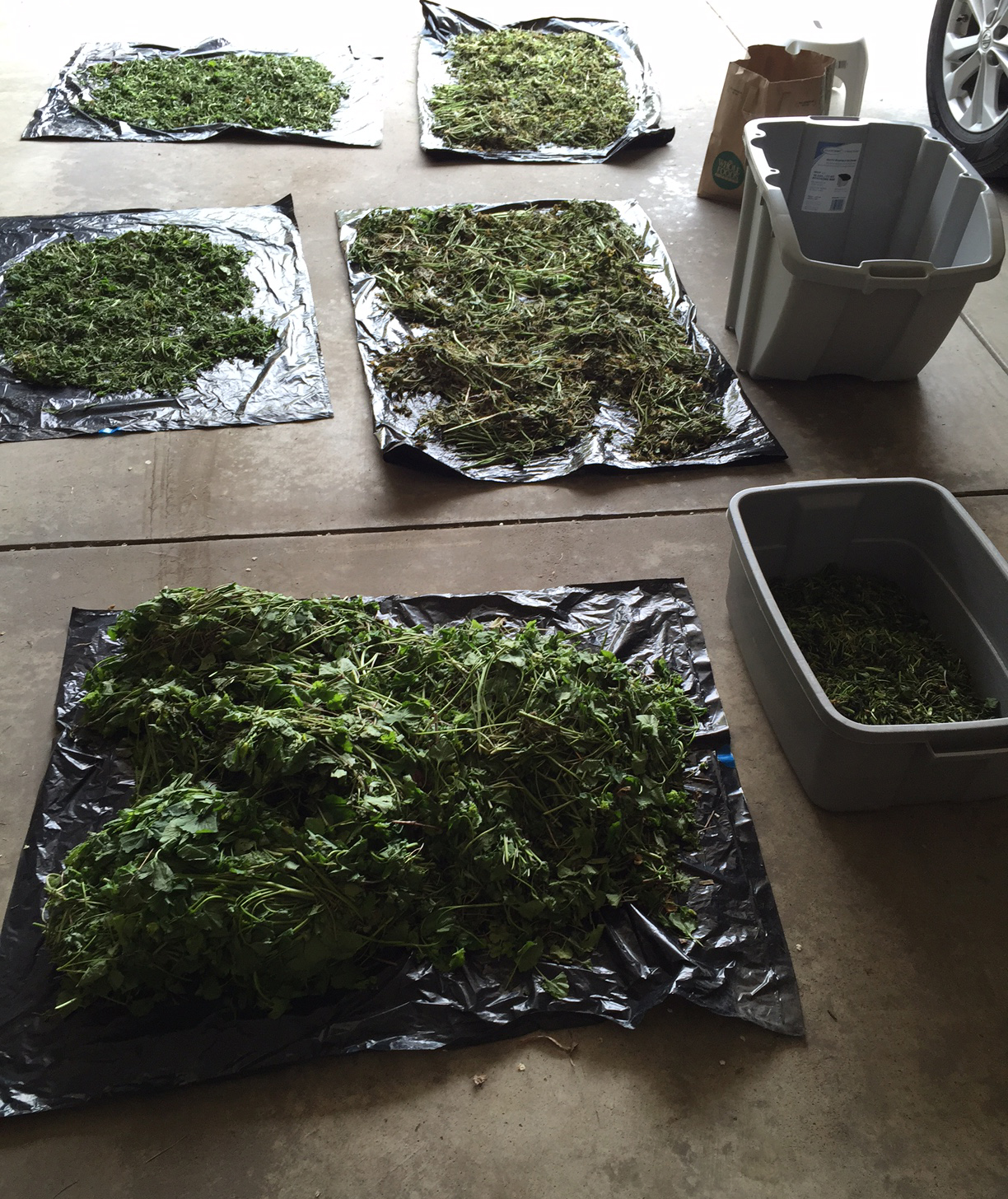
On Sunday, I was able to put it out in the sun to start the drying process. I would never have done this if it were at all windy for fear that some pieces would blow away, but it was a very still day. Since then, it's been drying in my garage. I've been making my way through each pile, cutting it into 1 inch pieces. Normally, I don't cut the plants until after they've dried, but there is so much and nowhere else to store it, so I'm trying to speed up the process. I think I'll have enough to make paper for the next five years. :)


Wednesday, April 20, 2016

Dame's Rocket - Round 2

Last summer, I tried to make pulp from invasive Dame's Rocket, but it didn't work. It wouldn't break down enough to chop even after boiling it several times. Maybe it's because I picked it while it was blooming. Who knows? However, I'm going to give it another shot. This past weekend I picked new growth Dame's Rocket at Fenner Nature Center during their Earth Day event. There were many volunteers helping to pick invasive plants that day, including a group of students from MSU. I could have hauled away 50+ bags, but I'm going to start with the two I collected and see if it works. Fingers are crossed.


I cut off the roots and will dry them in the sun over the next few weeks. You can see there are a few garlic mustard and motherwort plants tossed in as well.


Tuesday, March 22, 2016

Step 6: Alcohol Gel Transfers

The last step in making the endangered plant prints is the alcohol gel transfer. This is by far the least reliable part of the whole process as the transfers tend to work only about 50% of the time. I have yet to figure out the perfect amount of gel and the right amount of time to burnish the film as it varies greatly with each type of paper, the temperature and humidity of the room, the temperature of the gel, and how warm my hands are. However, when it does work, it's a beautiful thing.

Supplies: Purell hand sanitizer, Genuine DASS ART Classic Transfer Film, brayer, gloves

Below is a transfer of the shadow image of prairie smoke (Geum triflorum) onto paper made from phragmites.